by Gregory Ioannides
European Network of Research and Documentation of Performances of Ancient Greek Drama
As the first necessary step to support future comparative studies, the members of the Network have been creating a major research database. Available in Greek only for the time being, the Network Database already includes 1062 records, including performances of the following plays:
| Aeschylus | Seven Against Thebes, Persai, Hiketides, Oresteia (as a trilogy or separate plays) |
| Sophocles | Aias, Elektra, Philoktetes |
| Euripides | Electra, Iphigenia at Aulis, Iphigenia at Tauris, Medea |
| Aristophanes | Birds, Wealth |
| Menander | Dyskolos, Samia |
| Plautus | Epitrepontes |
The aim of the project is to document for publication the performance histories of ancient drama in different geographical areas, rather than just to establish an archive.
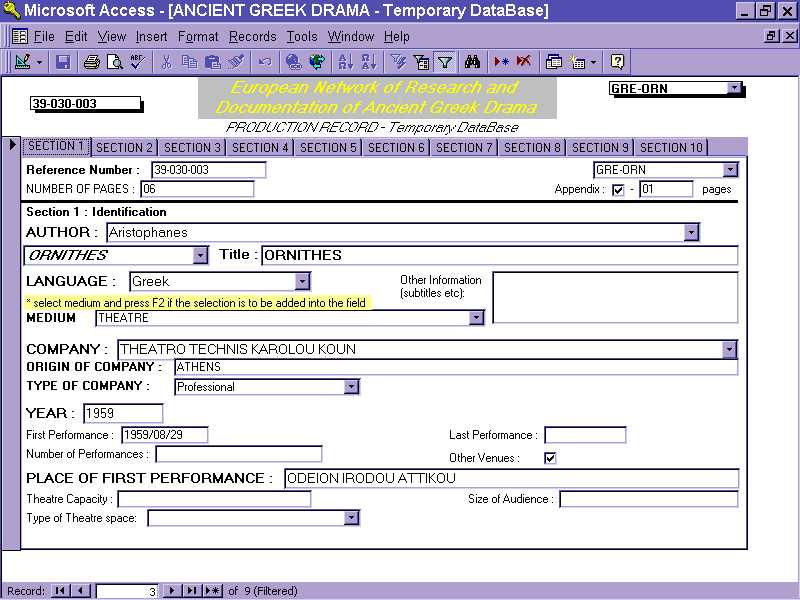
The Database will eventually store and recover all data provided by the partners of the Network. We have tried to form a consistent way of analysing and categorising every important datum of an ancient Greek drama performance into special fields. Thus, we have reached the point of dividing the information provided for a specific performance into ten different sections. Each of these sections contains a number of fields that conceptually belong to the same category of information.
Section 1: the basic information on a performance. It contains fields for the original title of the performance, the name of the company, the place and date of the first performance (exact date and year) and others.
Section 2: the 'Major Contributors' of the performance. Fields for the director and the translator of the performance, for the stage designer or the composer give the basic information on the contributors to each production.
Section 3: the names of the actors/actresses (roles) and the alterations in the cast
Section 4: information on the chorus leader and the chorus members of the production.
Section 5: the available sources, documents and other material available for further research.Special fields on primary and secondary sources, on materials for the specific performance etc. have been included:

Sections 6, 7 and 8: general information on the political and cultural interest of the performance, on its aesthetic conventions and on critic and audience responses.
Section 9: 'Appendix' - an open field where any other information or bibliographical documentation can be stored.
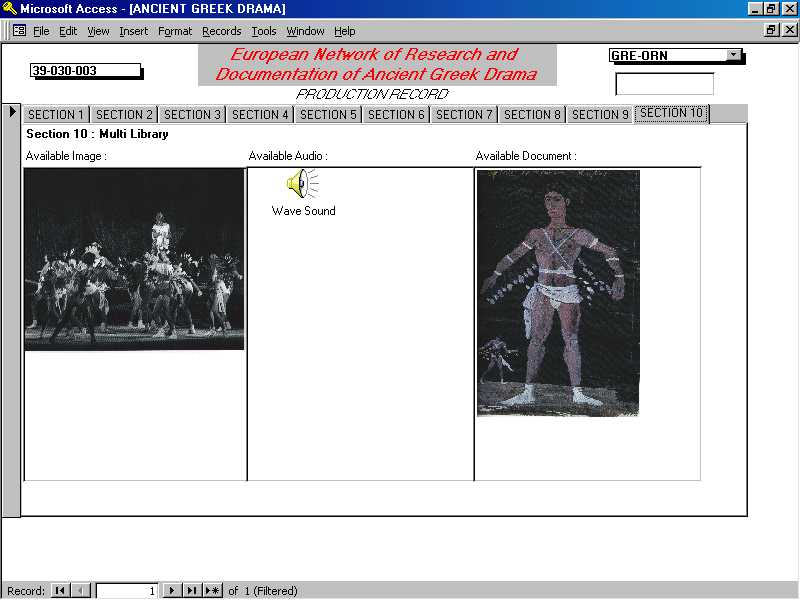
Section 10: the Multimedia Library of the Database. This includes a collection of documents (e.g. posters, programmes, scripts etc) as well as available audio and/or video recordings of the performance:
The format of the Database records is the result of the work of all partners of the Network and was established during the annual meetings that have taken place to date. However, while creating the database, it became necessary to add some more fields in order to prevent eventual loss of interesting information. We have tried to keep things as simple as possible for contributors. For example by creating three similar (and compatible) databases, we have been able to offer partners a choice concerning which software package to use:
i) Insiel QuerySys. This is a comparatively new piece of database software particularly recommended for the management of Archives because of its powerful ability to sort and/or search data. However, its non-propriety format makes it difficult for the user of average experience to input information.
ii) FileMaker Pro is considered to be the most user-friendly application of all and is particularly recommended for those who use the Macintosh
iii) Access Database, also user friendly, is perhaps the most widely used database application, and is certainly the one used by the majority of the partners. Those partners who do use Access have in hand a much more friendly version of the first database, as it has been much improved in response to feedback from the users.
However, all three options above require that a software package is bought and installed on the users PC. Therefore we have provided a fourth way to send information and it is now possible to enter data using a Microsoft Word form. These Word forms have been designed in order to facilitate partners who are unfamiliar with database programs. It is also hoped that in the near future the Network will provide a WebFormvia its own WebSite.
We have already integrated a computing system that will be able to automatically transliterate a language to its Latin transcription; the software is already operational for the Greek language. With this utility, we hope to be able to provide a bi-lingual database for each country, containing data both in its own country script and in its Latin transcription.
Finally, we have also integrated the Web database. With this facility partners will be able to transfer their data directly through the Internet. Full access to the Web Database will be limited to Network members for the foreseeable future.
The Greek Database on the Web
Some time ago the Greek team of the Networkdecided to improve the status of their research programme by publishing part of the already collected material (concerning more than 500 performances of Ancient Greek Drama in Greece) through the Web. This project can be regarded as a pioneer application among cultural projects in Greece, and it is considered as the very first step towards further development in correlating new Information Technologies with Humanities Studies.
However, before proceeding to the development of the Web-database, the designers' team of the application had to decide on some basic parameters; i.e., was it something to be addressed only to scholars or was the web development to address a wider (and so, to a less specialized) group of people? Which part of the information should be published through the Internet and what method for searching and reconstructing data ought to be followed so that concepts of integrity of information are fulfilled? A profound discussion among members of the Greek team took place in order to provide sufficient answers to these questions before proceeding to the development of the project.
Since only a part of the collected material was to be included to the Web-database, it was decided that the published data ought to reach a wider group of users, a group that besides scholars would also include students of humanities, teachers, artists and so on. It was felt that most of them would probably look in the database to find specific information concerning Greek performances related to Ancient Greek theatre, contributors of the performances, actors etc. This means that the designers of the Web-database had to have had in mind the need for the database to provide specific and verified information.
At the same time, other users of the database, such as students and teachers would probably want to have a wider perspective of the database material. They would search for correlations between different performances, such as Aeschylus' plays in Greece or, more specifically, performances of the Persians. Or, they would search for performances to which an eminent actor/actress or a director had made a personal contribution. Moreover, the database designers also had to consider this last user group to be less experienced in using web and database tools; in other words, the application also had to fulfill demands of an easy-to-use and open-to-all technological environment.
The designers' team came up with a solution that imitates the well-known 'Google' web tool in searching the established database and providing various results. 'Google' has known worldwide success due to its friendly environment and to its unbiased way of searching the database through keywords. Users of 'Google' start by searching the web with a key-word or a string; the search ends with a series of results which further provide links to other information, and so on. In that way 'Google' users can proceed to further and more profound information.
Figure 1 shows the first window of the Web database simple search environment. Users can search the database through a word or a string, which can be the name of an actor/actress, the company title, the date of the performance, etc. The example uses the word 'Κουν' ('Koun') as the keyword.
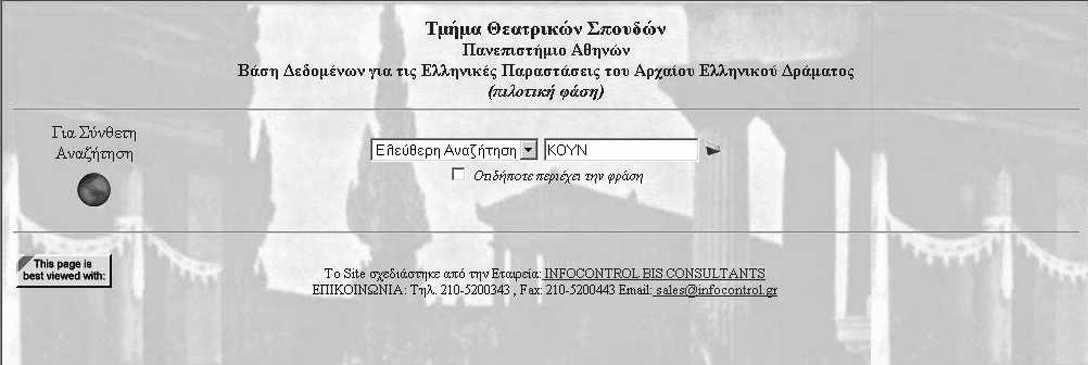
Fig. 1 The search environment of the Network's web database
In order to use this free search method, a Combo box, shown in Figure 1 on the left, is set by default to the '<ΑπλήΑναζήτηση' ('Free search') option Users can limit their search by choosing from the Combo box a more specific option, i.e., Director, Writer, Play, Year or Place of the Performance, or Company.
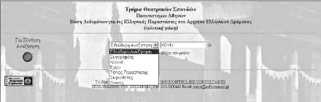
Fig. 2 Search options in the Network's web database
Figure 2 shows these options. Moreover, users are able to define their search in a more accurate way by noting whether the string they are looking for is part of a longer string (say 'Koun' for the nameKounelakis') or not. For this, an option box has been placed just below the search field.
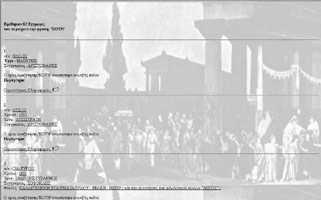
Fig. 3 Search results in the Network's web database
Figure 3 presents the results of the search. Some basic information of the performances (in which the word 'Κουν' is included) is shown in a list of performances sorted by date. This information includes the Play performed, the Year of the Production, the Author and the Company. A statement under each performance declares the field of the record that includes the word 'Κουν'. Each case in the list provides other information to the user through the 'Περισσότερες Πληροφορίες' ('More information') button. This way the user is able to see the whole record of each performance in the database (Figure 4).
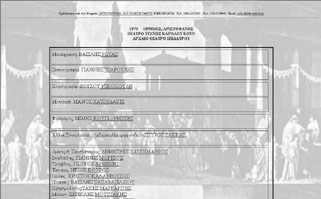
Fig. 4 A complete performance record in the Network's web database
As is clear in Figures 3 and 4, almost anything in the list (names, dates, plays etc) can be used as links to further information. This means that by clicking on these links, users can see the results of a Query that uses the linked word as keywords.
In our example the link-word 'ΠΛΟΥΤΟΣ' ('Ploutos') was selected.
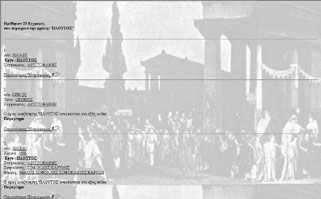
Fig. 5 'ΠΛΟΥΤΟΣ' ('Ploutos') selection
Figure 5 shows the new results of the Query. Now, the list consists of performances of 'ΠΛΟΥΤΟΣ', sorted again by date. Similarly, users can use any link of the Web-tool to find lists of performances grouped by a string. This way any user can 'wander' through the database, whether he/she uses the web tool for educational reasons or just for the sake of mere curiosity!
This is the more simple way for searching the database through the web. However, a more sophisticated method has also been included in the environment for those users who ask for more specific information.
Figures 6 and 7 present an example of the 'Σύνθετη Αναζήτηση' ('Composite Search') tool and its result. By fulfilling more than one field users can go directly to specific performances and data.

Figs. 6 & 7 The Composite Search tool in the Network's web database
The web tool is just the first step for the development of a more sophisticated database tool. Many users of the existing application have already sent to the Greek team their opinion or their remarks, kindly contributing to the improvement of the tool and to the verification of the collected data.
Gregory Ioannides
European Network of Research and Documentation of Performances of Ancient Greek Drama, Athens, Greece.